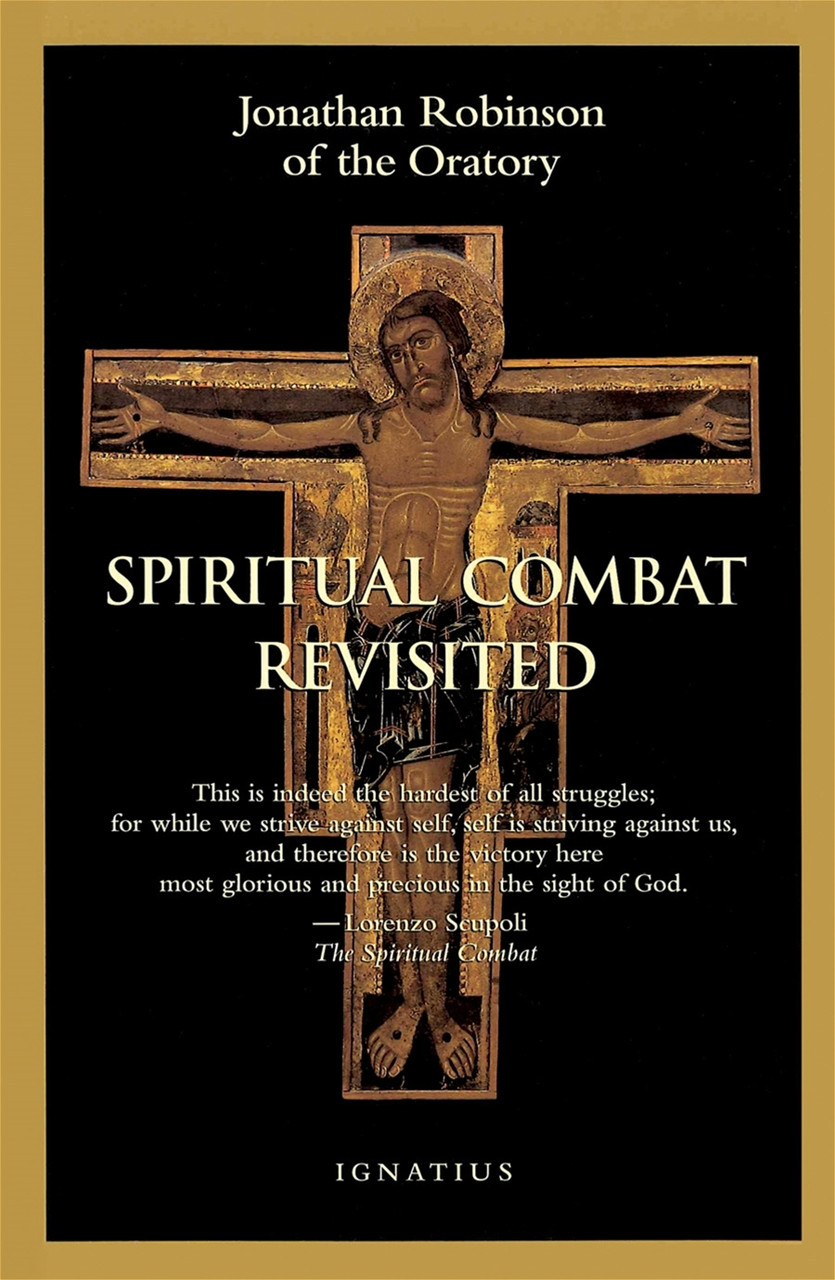
The Spiritual Combat is one of my favorite religious works. Its author, Lorenzo Scupoli, had immediate need of his own message. Shortly before its first publication, his own religious order convicted him in a trial, imprisoned him for a time, and sanctioned him. The reason is unknown, but Scupoli was not rehabilitated until a few months before his death… twenty-five years later. Remarkably, he remained a member of the order, and continued work on the book.
God has rewarded his patience and humility, as The Spiritual Combat became an enormously popular book, even in non-Catholic circles: as one example, a Greek Orthodox monk revised and published his own version, Unseen Warfare. This success is all the more remarkable given that Scupoli’s book does not strike one as very well-organized, or at times even well-written. The author seems to have assembled notes and letters from over the decades — most clearly from his time as a spiritual director of women religious. At some times clear and somewhat succinct, at other times the book becomes grows tedious or repetitive, then wanders off. Sentences ramble on, and ideas that ought to go together are often separated by unrelated ideas. Nevertheless, the essence of his message pierces whatever the messenger’s inadequacies, to say nothing of those of the translator. Like all books, The Spiritual Combat was written in a particular cultural context, and some might find its terminology or attitudes offensive. Readers unused to thinking while they read, or to generosity to the author, may have a hard time with this book. For example, the term “hatred of oneself”, or “self-hatred”, should not be taken too literally. Its meaning in the spiritual life is not akin to the hatred nursed by a person who wishes to end the life of another; to the contrary, self-hatred and the self-denial that accompany it can be, strange as it may sound, one of the highest forms of self-love. I first started this translation a quarter-century ago (roughly AD 2000) after coming across an Italian edition online. I did quite a bit of it at first, then something distracted me, and never got around to finishing it. The webpage I used as my source has since disappeared; as far as I can tell and remember, this webpage contains that text. This series of web pages constitutes a work-in-progress. I translate a chapter here and there in my spare time as a hobby — after all, my job at NC State at North Carolina Wesleyan College at the University of Southern Mississippi at Peraton Engineering is that of a mathematician, not a translator of religious works — so if it does not yet appear complete (or even particularly good), that is for good reason.