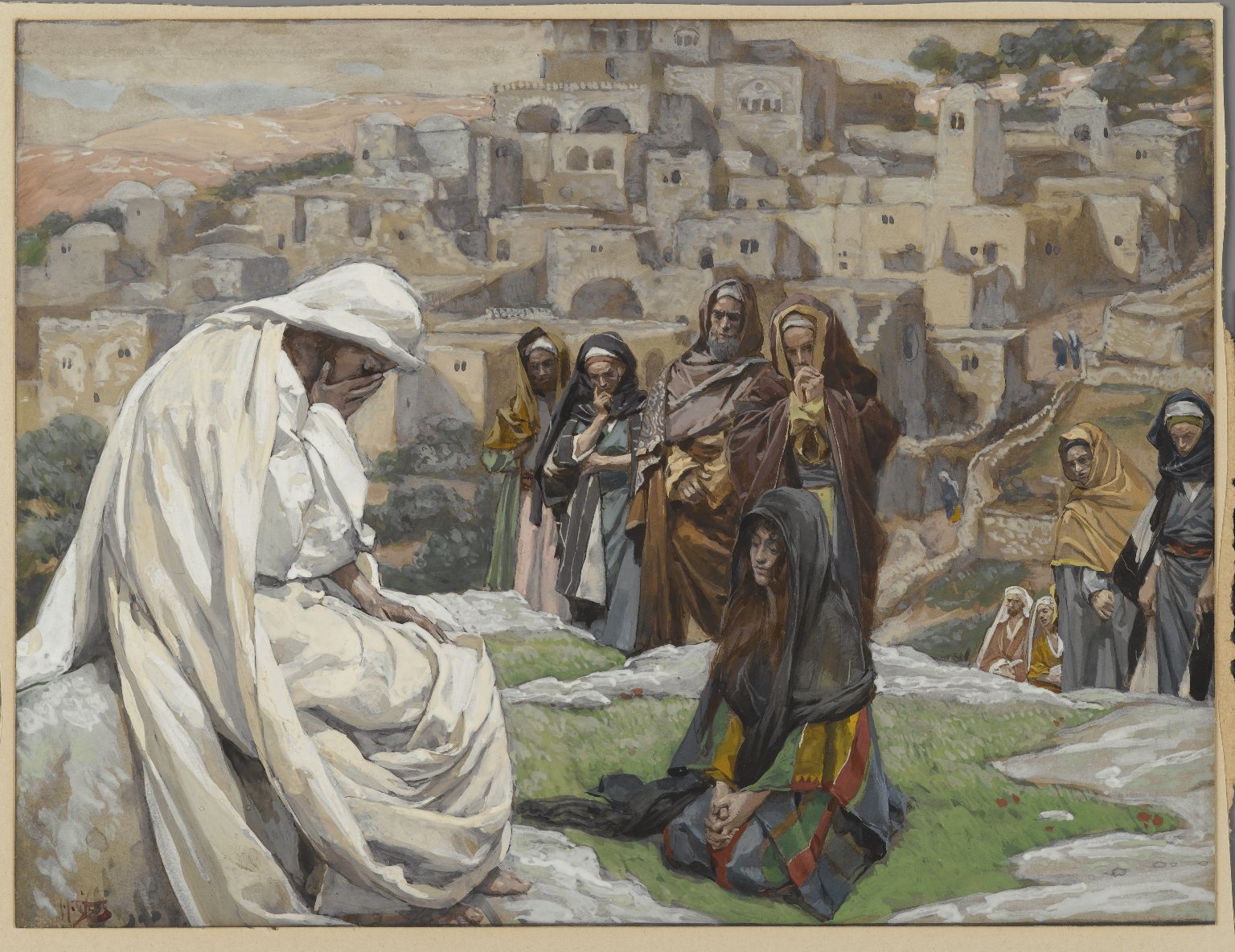
Jesus Wept
One of the many reasons the Johannine literature appeals to me is its elegant weaving together of our Lord’s dual natures. Start with its opening lines:
In the beginning was the Word,
and the Word was with God,
and the Word was God.
He was in the beginning with God.
All things came to be through him,
and without him nothing came to be.
What came to be through him was life, …
To a Greek listener of the time, this would certainly have come across
as more than a religious claim, but a philosophical one, as well;
the Greek term λογος that we translate as “the Word”
was used as a term for divinity by multiple schools of philosophy,
such as the Stoics and Philo of Alexandria —
all contemporaries of Jesus and the first evangelists.
Now move to the center of the Gospel:
and the Word was with God,
and the Word was God.
He was in the beginning with God.
All things came to be through him,
and without him nothing came to be.
What came to be through him was life, …
— John 1⋅1-4a
And Jesus wept.
So the Jews said, “See how he loved him.”
Halfway through the Gospel, God’s Word,
who participates in the creation of all things,
has not merely become human,
not merely been baptized and worked miracles such as
transmuting water into wine in order to rescue a wedding:
he is so fully human that emotion overcomes him
and he weeps at the death of a friend.
His tears are not hidden, and his grief is deep enough
that those standing nearby remark
that Jesus must have loved his deceased friend greatly.
“Jesus wept.” When I was a child, they taught me at Sunday School
that this is the shortest verse in the Bible.
I recently asked myself how much that depends on the translation;
the Southern Baptists I grew up with relied on the King James,
where the verse is a mere two words,
but the Catholic translation above is three.
I looked up how some other languages have translated this verse,
and copy them below, in order of descending comprehension on my part:
So the Jews said, “See how he loved him.”
— John 11⋅35
| Language | Translation |
|---|---|
| Italian | Gesù scoppiò in pianto. |
| Latin | Et lacrimatus est Jesus. |
| Russian | Иисус прослезился. |
| Spanish | Y Jesús lloró. |
| French | Jésus pleura. |
| Greek | ἐδάκρυσεν ὁ Ἰησοῦς. |
Jesus burst into tears.
The Italian Jesus doesn’t just weep; he bursts into tears.
That illuminates Jesus’ humanity in a way in a new way,
the sort of way you’d expect from someone who later writes:
What was from the beginning,
what we have heard,
what we have seen with our eyes,
what we looked upon
and touched with our hands
concerns the Word of life—
for the life was made visible;
we have seen it and testify to it
and proclaim to you the eternal life
that was with the Father and was made visible to us… — 1 John 1⋅1-2
what we have heard,
what we have seen with our eyes,
what we looked upon
and touched with our hands
concerns the Word of life—
for the life was made visible;
we have seen it and testify to it
and proclaim to you the eternal life
that was with the Father and was made visible to us… — 1 John 1⋅1-2